The Crew Liaison
A crew is a committee. From inside the cluster you can watch it work: agents convening, findings arriving, signals settling. From outside, a client should not have to. The crew liaison is the operator’s door for other agents: one MCP endpoint that fronts every crew in the cluster, takes a question, and hands back the crew’s synthesized answer.
What the client sees
Three tools, and nothing about the discussion’s substance.
| Tool | What it does |
|---|---|
list_crews | The crews that can be asked: name, namespace, what each is for, whether it is ready. |
ask | Starts a discussion with a crew and returns a ticket. It waits up to 45 seconds first, so a quick crew answers in the same call. |
get_answer | Reports a ticket: pending, answered with the answer, or failed with the reason. It too waits up to 45 seconds, returning the moment the answer exists. |
The question goes in and the synthesis comes out. Agent names, consensus signals, findings, tool output, and retrieved context stay inside the cluster. A pending ticket does carry one number, the count of contributions gathered so far, so a client can tell a live discussion from a stalled one. It names nobody.
Why a ticket
A crew deliberates for one to several minutes. Most MCP clients time a tool call out before that; Claude Code’s default is sixty seconds. A tool that blocked for the whole discussion would time out, lose the answer, and tempt the client to ask again, spending the GPU twice.
So the liaison never blocks a call for longer than 45 seconds. ask returns the
ticket inside that window whatever the crew is doing, and get_answer is a long
poll: it waits up to 45 seconds and returns as soon as the crew settles. The client
calls it until the status is answered. We call this the YDY pattern, “Ya Done
Yet?”, and it works with every client because it needs nothing from them but
patience.
Two details make it forgiving:
- A retry rejoins. If a client asks the same crew the same question while the first discussion is still running, it gets the same ticket back. A timed-out client that asks again does not start a second moot.
- The hint tells the model what to do. Every pending result says, in plain words,
to call
get_answerwith the ticket and not to ask again. An LLM client reads it and behaves.
Clients that support long-running calls get the same behaviour for free. Claude Code moves any tool call past two minutes into a background task, so a chain of 45-second polls simply runs in the background until the answer is in.
Watching the moot from the dashboard
The client sees only the answer, but the operator’s dashboard shows the whole moot as it happens: which agents the coordinator convened, each finding as it lands, the signals, and the synthesis. Open the crew’s discussions page while a client is waiting on a ticket and the two views line up: a ticket on one side, a committee at work on the other.
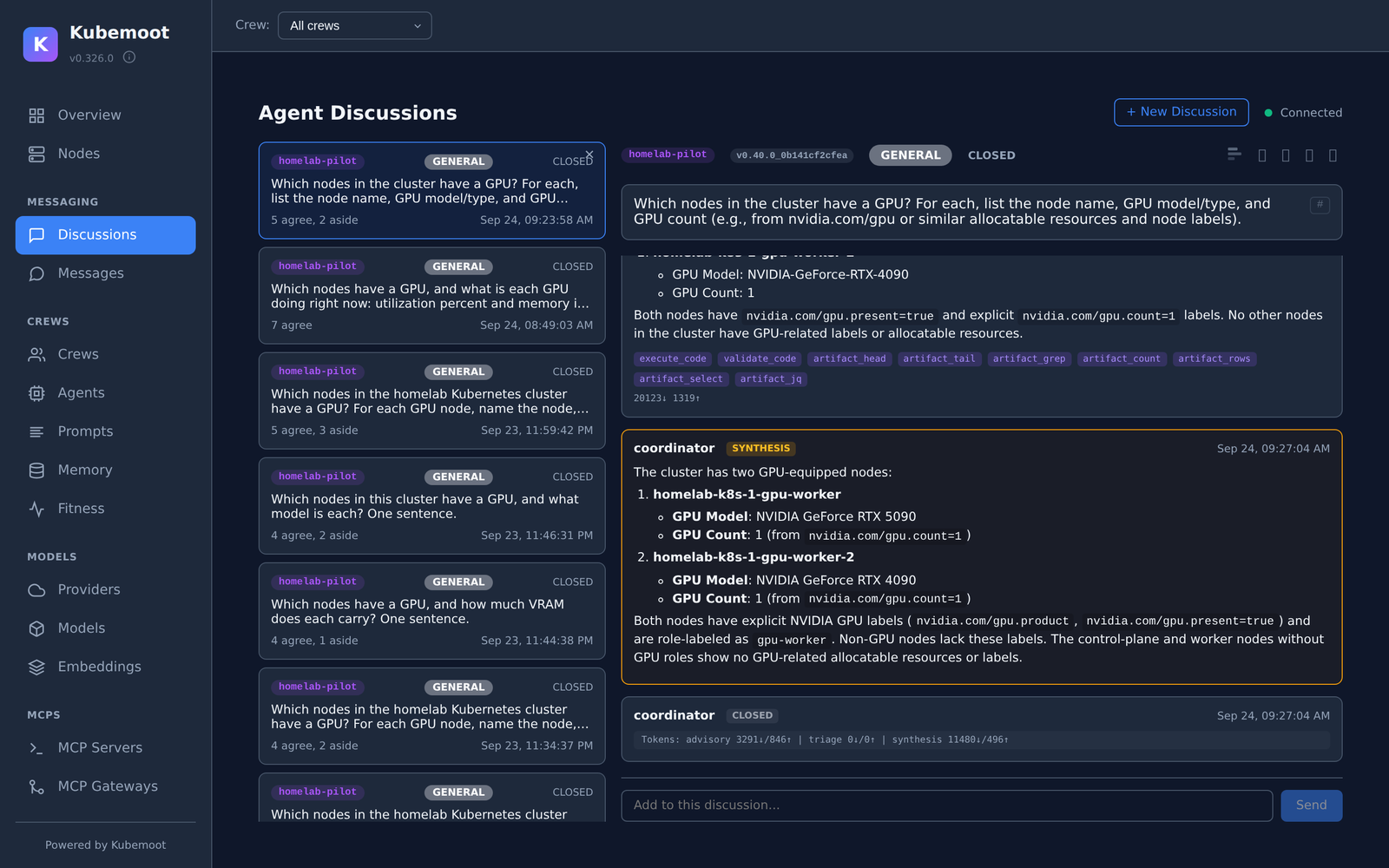
A clean run, as timed against a Homelab Pilot crew of small models on two GPU nodes:
| Time | Client call | Result |
|---|---|---|
| 0s | ask | returns at 44s with a pending ticket |
| 44s | ask again, same question | the same ticket: a retry rejoins |
| 45s, 101s, 145s | get_answer | pending, contributions 2 |
| 178s | get_answer | answered: the two GPU nodes and their models |
Four calls, none longer than 45 seconds, one discussion.
Where it runs
The liaison ships in the operator chart and is on by default, cluster-internal, at
the Service <release>-liaison on port 80, path /mcp. It lists Crew resources
across the cluster with a read-only role and reaches each crew’s discussion gateway
at its in-cluster Service. Tickets live in memory; a restart forgets them and the
client asks again.
liaison:
  enabled: true
  maxInflight: 4          # discussions at once; each spends GPU time
  auth:
    token: ""             # bearer token for /mcp; or existingSecret + key
  expose:
    enabled: false        # HTTPRoute at /mcp on the chart's gateway listener
    hostname: ""          # defaults to gateway.hostname
Set a token whenever the endpoint is reachable from outside the cluster, unless an
edge in front of it authenticates (a Cloudflare Access application with a service
token, for example). maxInflight caps concurrent discussions; a client that hits
the cap gets a tool error telling it to try again in a minute.
Connecting a client
- Claude Code: one command.
- Claude Desktop: through a small local bridge.
- Anything else that speaks MCP over Streamable HTTP: point it at
/mcp. The endpoint is stateless and answers with plain JSON, so a curl call works too:
curl -s -X POST http://localhost:18080/mcp \
  -H 'Content-Type: application/json' -H 'Accept: application/json' \
  -d '{"jsonrpc":"2.0","id":1,"method":"tools/call",
       "params":{"name":"ask","arguments":{"crew":"hello","question":"What is the capital of France?"}}}'