Claude Code
Claude Code speaks MCP over HTTP natively, so connecting it to the crew liaison is one command. See The Crew Liaison for what the tools do and why the answer comes by ticket.
Try it against any cluster you can reach
Port-forward the liaison’s Service and add it as a local server:
kubectl -n kubemoot port-forward svc/kubemoot-operator-liaison 18080:80
claude mcp add --transport http kubemoot http://localhost:18080/mcp
Start a new Claude Code session and ask in plain language:
Ask the homelab-pilot crew which nodes have a GPU.
Claude calls list_crews if it needs the name, then ask, then get_answer until
the crew has settled, and reports the answer. A crew takes one to several minutes;
each call returns within 45 seconds, and Claude Code moves the wait into a
background task past two minutes, so the session stays responsive.
While the ticket is pending, the operator’s dashboard shows the moot itself: the agents convened, each finding, and the synthesis arriving.
From a script
The same works headless, for a demo, a check, or a CI step. An MCP config file names
the liaison, and claude -p runs one prompt with only that server and its tools
allowed:
cat > kubemoot-mcp.json <<'EOF'
{"mcpServers":{"kubemoot":{"type":"http","url":"http://localhost:18080/mcp"}}}
EOF

claude -p --mcp-config kubemoot-mcp.json --strict-mcp-config \
  --allowedTools "mcp__kubemoot__list_crews,mcp__kubemoot__ask,mcp__kubemoot__get_answer" \
  "Hey homelab-pilot crew, which nodes have a GPU?"
Claude Code polls the ticket for you and prints the crew’s answer when it settles.
What a session looks like
A real exchange from the reference cluster (a Homelab Pilot crew on two GPU nodes), run with the scripted command above. Claude Code turned the prompt into a fuller question for the crew, polled the ticket three times, and printed this after 196 seconds:
Hey homelab-pilot crew, which nodes have a GPU?
The homelab-pilot crew says two nodes have a GPU:
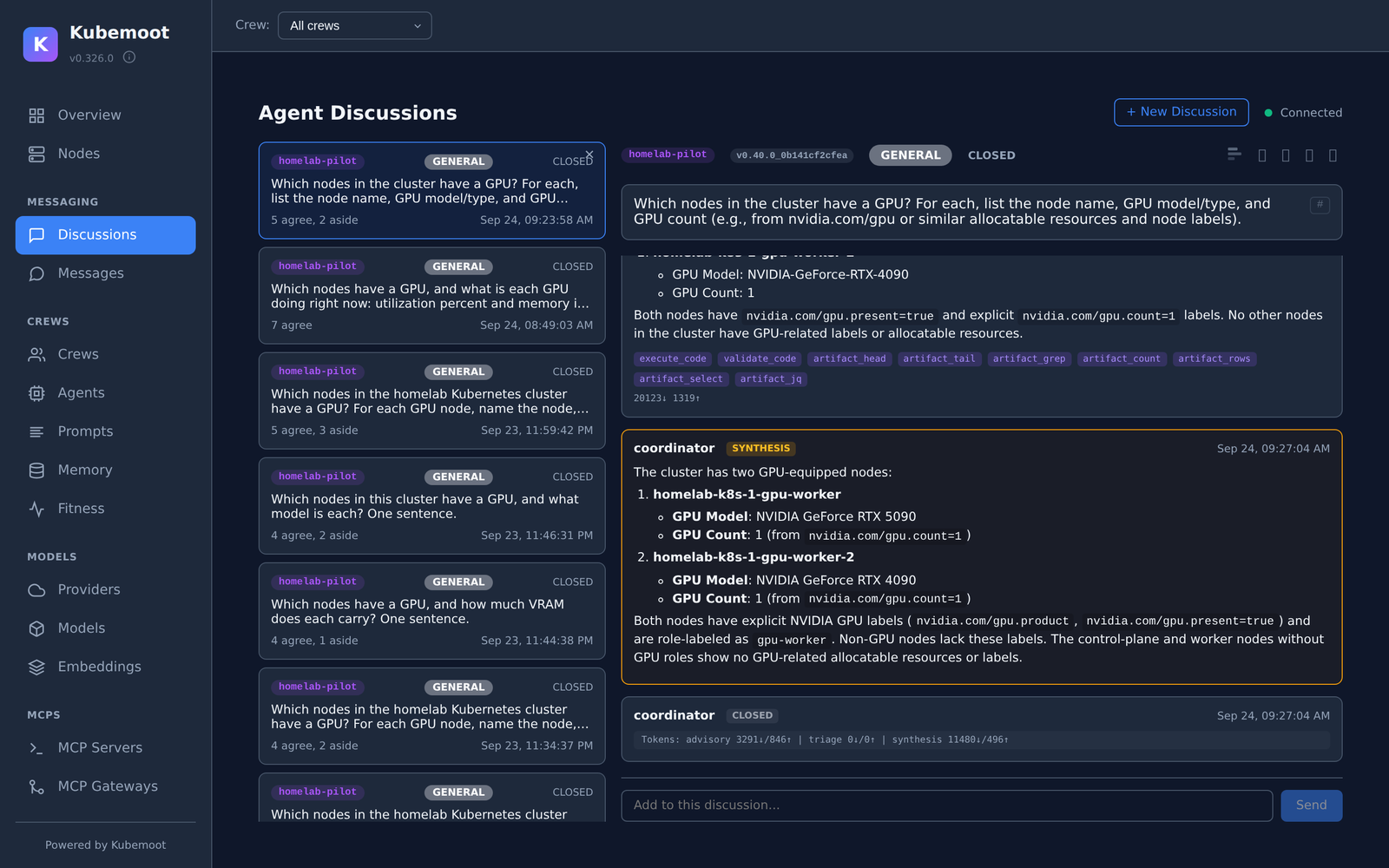
Node GPU Count gpu-worker-1 NVIDIA GeForce RTX 5090 1 gpu-worker-2 NVIDIA GeForce RTX 4090 1 They found this from the node labels. Both nodes are labeled
nvidia.com/gpu.present=truewith a matchingnvidia.com/gpu.product, and both have thegpu-workerrole. The control-plane and the other workers have no GPU labels or GPU resources.
Two things to notice. Claude Code never saw the agents: it saw ask, a few
get_answer calls, and one answer. And the caveats are the crew’s own words, not a
summary made outside the cluster: a crew that flags what it could not verify, such as
a metrics source that came back empty, is a crew you can act on.
The same moot on the dashboard, five agreeing findings and two standing aside before the synthesis:
Through a public route
With liaison.expose on and a hostname routed to the cluster:
claude mcp add --transport http kubemoot https://moot.example.org/mcp \
  --header "Authorization: Bearer <token>"
Behind Cloudflare Access, send the service token headers instead:
claude mcp add --transport http kubemoot https://moot.example.org/mcp \
  --header "CF-Access-Client-Id: <id>" \
  --header "CF-Access-Client-Secret: <secret>"
If a call times out anyway
Claude Code’s default tool timeout is sixty seconds, above the liaison’s 45-second
cap, so this should not happen. If your client is stricter, give the liaison its own
timeout in .mcp.json:
{
  "mcpServers": {
    "kubemoot": {
      "type": "http",
      "url": "https://moot.example.org/mcp",
      "timeout": 120000
    }
  }
}
A retry of the same question rejoins the running discussion rather than starting a second one, so a timed-out call costs nothing but the wait.